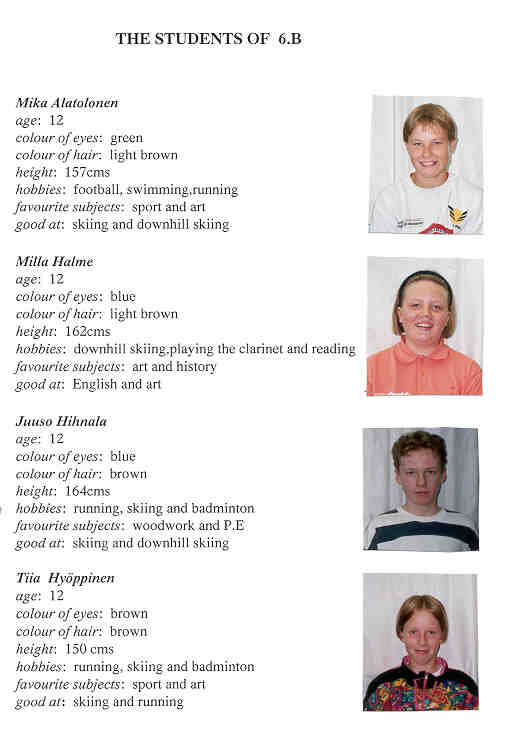
At first pupils introduced themselves. They
made introduction leaflets
and sent them to their foreign fellow pupils.
The pupils made posters after collecting information for them.
That was the most difficult work. Here are some examples.
We are happy to welcome you to Keminmaa, Finland. This is where
we live. The Keminmaa commune:
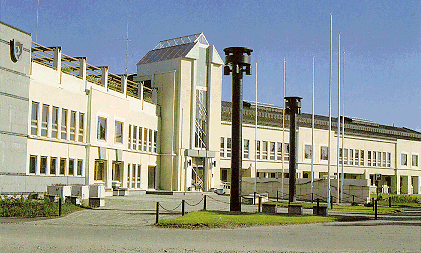
| founded in 1865 area: 627sq kms, population: 10 000 Commune House of Keminmaa |
|
 Photos: Jari Rajanen & Timo Julkunen |
We live a ten-minute-drive to Kemi and twenty-minute-drive to the border of Sweden. Our climate is warmer than people in the south think. Our summers are short but warm and light. Autumn colors are called "Ruska". The dark time of the year in October - November is called " Kaamos". Snow covers the ground for at least six months a year in our area. Frosts and northern lights belong to our winter, too. We have great outdoors. The river and the sea give possibilities for boating and fishing.
The River Kemijoki flows from the north to the south through
Keminmaa and runs into the Gulf of Bothnia. The river Kemijoki is the longest in Finland.
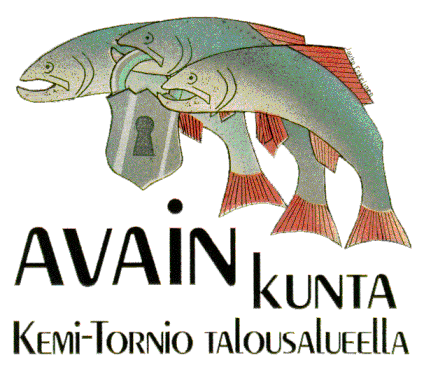
It´s sources run from the fells of Lapland. The Keminmaa coat of arms shows a salmon and
a lock. Salmon was very important before the hydro-electric plants were built. The lock
tells that Keminmaa was a significant gate to Lapland.
The name of our school is Comprehensive school of Kirkonmäki, Keminmaa. It is situated in
a village called Laurila, which is the centre of Keminmaa commune. The school building was
finished in 1975. There are approximately 260 pupils aged from 7 to 13, classes 1-6. We
have 15 teachers. Our headmistress is Mrs Mervi Hopia-Jaakkola.
In Finland we go to a nine-year comprehensive
school. We are lucky to have free meals, books and other things. In the new curriculum we
have the European dimension. We have partner schools in England, Hungary, France, Germany,
Sweden, Denmark and Norway. Our school took part in forest project. We can choose optional
extra music, art or P.E lessons. Our school has Internet connections. Just recently we got
video negotiation facilities.
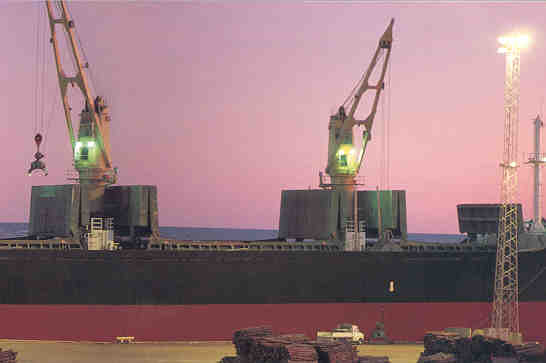
The port of Kemi, Laplands gateway to the world, consists of
two harbours, Ajos and Veitsiluoto. They are situated 10 kms south of Kemi. Ajos has four
berths for dry cargo ships, about thousand meters altogether and an oil jetty. The depth
varies from 5.3m to 10m. The lengths of piers are from 160m to 350m. To ro-ro ramps are of
26-30 meter wide. There are two railway trucks and two shore cranes with the capacity of 6
tons. The Veitsiluoto harbour is mainly used by Veitsiluoto Company, which is one of the
biggest paper and pulp factory in Europe. Veitsiluoto harbour has seven berths, with total
length about 800 meters. The depth is 7 meters.
We made a bus trip to the Port of Kemi on
September 30 th, 1997. The weather was wet and windy. We made an interview and learnt lots
of things about the harbour. It was founded in 1869, the same year as city of Kemi. We
heard there is the staff of 150 of which permanent are 120 and temporary 130. At the
same time there can be ten vessels. The largest ship in the port was 370 meters long and
33 broad. The ships come from all over the world.There are regular weekly freight
services,to Germany, Great Britain and Netherlands. Mostly they carry pulp. 500 tons of
raw wood is imported. Both Ajos and Veitsiluoto harbours export for the most part forest
industry products. In Veitsiluoto harbour we saw an Estonian cargo ship which had carried
birch wood for the needs of Veitsiluoto factory. We also saw a Swedish ship, which was
loaded with Finnish paper to be carried to Amsterdam. We were allowed to go into the ship.
It was interesting to see how the loading goes on. The noise was terrible due to the
different machines. We went up to the navigating bridge, too. It was great ! Before
returning to school we drove to Ajos harbour and saw four cargo ships and the icebreaker
Sampo. After that we had a nice lunch in the lunch room of Veitsiluoto factory.
The Port of Kemi
Here in northern Finland, near the Arctic Circle, the frosts can make the ice 1 meter thick. Then the shipping lanes are kept open with the help of icebreakers. Sampo has been icebreaking for thirty years. Nowadays Sampo offers also cruises for tourists from December to May. The cruise offers many ways of enjoying the thrills of the icy sea. In summertime Sampo serves as a cafe for tourists.
The river Kemijoki is the longest in Finland, about 552 kms. The tributaries of the river Kemijoki are the River Ounasjoki, Luiro, Kitinen and Kemihaara. The River Ounasjoki gets its sources from the fells of western Lapland. It joins the mainstream at Rovaniemi near the Arctic Circle. The river Ounasjoki was protected by a special law in 1983. The sources Kitinen, Luiro and Kemihaara start from the forests and marshes of northern and eastern wildernesses. They join together at Pelkoseniemi and flow into lake Kemijärvi. Then the waters pass Rovaniemi and flow south-west into the Gulf of Bothnia.
The Nature of the River Kemijoki has completely change in one generation. The River Kemijoki has for thousand of years been of vital importance, source of food and route for the transport and passage to Lapland. The last dam in the river Kemijoki mainstream, Taivalkoski, needed lots and lots of concrete. With that amount you could have built a hundred blocks of flats with 7-8 floors.
Timber floating in the river Kemi
Photo: Timo Julkunen and Jari Rajanen
THE BRIGHT SUMMER AND DARK WINTER CHARACTERISE THE AREA
Fish in the waters: trout, pike, perch, white fish, burbot, salmon
Trees in the area: birch, (the most common leaf tree), maple, rowan, bird cherry, aspen,
willow, dwarf birch, spruce, pine, conifer
Animals: reindeer, bear, hare, fox, wolf, elk/ moose, glutton, arctic fox, lemming, mink.
 |
|
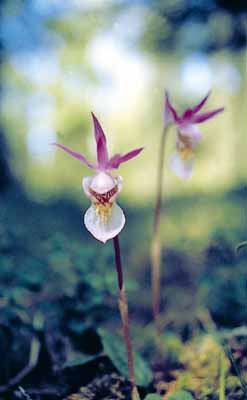
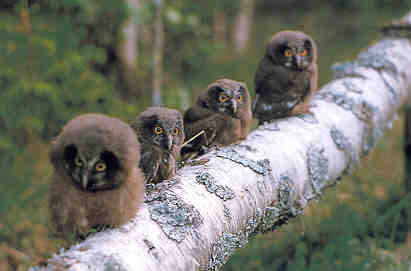
| There is rich bird life in Keminmaa (Aegelius Funnerus) | Keminmaa is well-known of its flora ( Calypso bulbosa ) |
Forests: The main natural resources of Lapland are the forests.
In the cold climate they have a slow growth. A pine needs 150 years to attain it´s full
size in our area. In northernmost part of Lapland it needs 250 years. Marshes and bogs
cover the third of the area. Reindeer herding: Reindeer feeds on lichen, hay and the beard
moss hanging on the spruce. In autumn it eats mushrooms and berries. In winter it digs its
food under the snow. At present there are about 300 000 heads of reindeer in Finland.
Main crops: barley, oats, rye.
THE CLIMATE
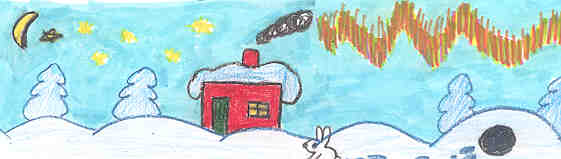
The climate changes from season to season. The average temperature of the year is -1- +1 Celsius. The coldest in February average -11- -14 C. T he warmest in July average, +12-16 C. The water temperature in the river Kemijoki always stays below 20 degrees Celsius. The river freezes in November and we can see the breaking up of the ice in the first part of May. Spring is the time of rapid awakening. Snow melts in the beginning of May in our area but a month later in the northern parts of Finland. Summer is light and warm and beautiful. It never gets dark here in summertime. For one month in June- July we can see the sun all through the night if the sky is clear. In summer Lapland provides unique opportunities for cross-country hiking and camping. If you are not scared of millions of mosquitoes whining in your ears and thirsting for your blood. Autumn scenaries in Lapland are colourful. After the first frosts the leaves on the trees and bushes turn bright yellow, orange and different shades of red. First snow falls usually in October. Snow covers the ground for six to seven months. In December the days are very short and dark. We can't actually see the sun at all for month. That time is called "Kaamos". March and April are great time for the skiing season in Lapland. Lots of tourists visit the skiing resorts on the fells. On cold, frosty winter nights we can see a marvellous spectacle in the sky called "Northern Lights" or Aurora Borealis.
THE POPULATION
Mostly the people in Lapland live by the rivers
and lakes. The larger population centres are Kemijärvi (12400), Rovaniemi (33000) and
Kemi (25600). In the communes around the river Kemijoki there are about 130 000
inhabitants. In the whole Province of Lapland there are 200 000 (area 99 134 square kms.).
There are a lot of summer cottages by the rivers and lakes for spare time activities. We
have a small minority of Lapps, about 4000.
KEMIJOKI OY
KEMIJOKI OY is a company which produces electricity. It has
fourteen hydropower plants and two reservoirs. Artificial lakes and regulated natural
lakes are used for storing flood waters from melting snow and the rain waters in summer.
Regulation of the watercourses may cause damage to migratory fish, habitation,
agriculture, reindeer herding and some plants and animals may be lost. The variation in
the water level can also cause some damage to the shoreline. The regulation of the
watercourses produces electricity, controls the floods and it has added employment
opportunities in the area.
Other results are presented
in our Comenius photo gallery - please take
look.